

Introduction
“Public services touch on every aspect of our day to day lives and are fundamental to delivering the action we will take to eradicate child poverty, grow the economy, and tackle the climate emergency.”
Programme for Government 2024-25”, ScotGov, 2024, p.32
From healthcare, education and social care, to transport, policing, water, waste management, and much more besides, the Scottish public sector provides fundamental services to communities across Scotland.
Accounting for 22% of total employment, the sector and services it provides directly impact the most important issues facing citizens today: poverty, inequality and the climate and ecological crises.
Given the size of the sector and scale of the challenges it is tackling, it is in everyone’s interests for public services to work as well as they can.
This is the reason why ‘Ensuring High Quality and Sustainable Public Services’ is one of the Scottish Government’s four key priorities for 2024-25, underlined by the publication of Scotland’s Public Service Reform Strategy earlier this year.
So, why does this matter to the Scottish Climate Intelligence Service (SCIS)?
Because SCIS is not just about net zero or local climate action: at its core, SCIS is all about public service reform.
In this blog, we’ll explore what is meant by ‘public service reform’, how it applies to Scotland, and how SCIS’ mission to build capacity and capability in local government to reduce area-wide emissions contributes to public service reform while accelerating climate action by councils across Scotland.
What does Public Service Reform mean?
Put simply, public service reform is all about making public services and the public sector that provide them work better for the citizens and communities they serve.
There is a lot of interesting thought and work in the public service reform space at the moment, most of which is underpinned by a recognition of the need for good public services and a strong public sector in the context of an increasingly challenging social, economic and political climate.
Good thinking in this area ranges from a recognition of the prevalence of outdated modes of thinking in public service delivery to the rise in prominence of ‘mission-led government’ and calls for a public sector that ‘does with’ rather than ‘does to’.
Examples like the Cabinet Office’s Test, Learn and Grow Programme, Clackmannanshire Council's Transformation Space and several case studies described by the Improvement Service highlight ways in which both national and local government are responding to this challenge, with a focus on place-based, iterative and preventative action.
Public Service Reform in Scotland
In the Scottish context, contemporary ‘public service reform’ is a direct response to the Commission on the Future Delivery of Public Services – the Christie Commission – established by the Scottish Government in 2010.
Published in 2011 in the context of increasing demand for public services while spending was constrained under austerity, the commission’s detailed report identified a series of areas where ‘transformative change’ was needed across public services in Scotland owing to fragmentation, top-down governance, outdated approaches, lack of transparency and accountability, and short-termism.
The Commission outlined four key elements of a successful reform programme:
- Build public services around people and communities.
- Public service organisations should work together effectively to achieve outcomes.
- Public service organisations should prioritise prevention, reduce inequalities and promote equality.
- Public services should constantly seek to improve performance and reduce costs while being open, transparent and accountable.
While these four elements were underpinned by over a hundred pages of policy analysis and an involved consultation process, they have since been simplified and referred to in policymaking circles as the ‘4 Ps’: 1. People 2. Partnership 3. Prevention and 4. Performance.
Scotland’s 2025 Public Service Reform Strategy leans on this framework, outlining 17 focus areas across these ‘4 Ps’, with the addition of a fifth - ‘Place’ - to answer the question: “What needs to happen to enable systematic change?”. You can see these in the diagram below.
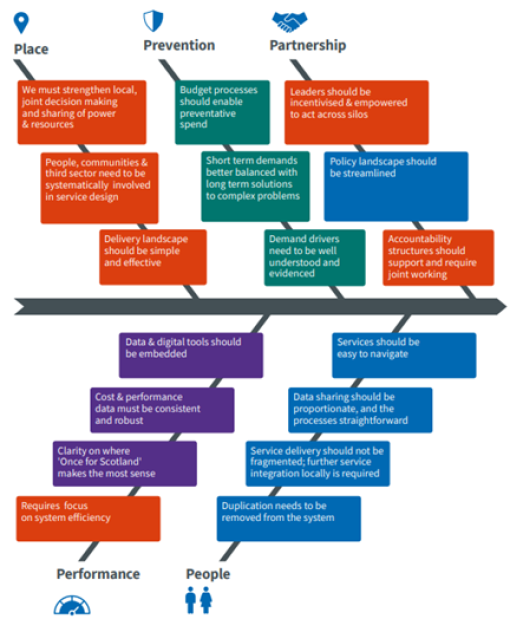
'Root Cause Analysis: What needs to happen to enable systematic change', Scotland’s Public Service Reform Strategy — Delivering for Scotland, p.11, 2025. Download a text description of this diagram.
While this blog is not the place to describe and analyse each of these outcomes in-depth, each of these blocks represents a significant strand of work across Scottish public sector bodies. Delivering them will require significant transformation across the board.
SCIS and Public Service Reform
SCIS are fortunate to work with all 32 local authorities across Scotland. Our mission is to build capacity and capability within local government to reduce area-wide emissions, with all the additional benefits this action brings.
Building capacity and capability goes beyond reducing carbon emissions.
Capacity means the ability of local government to act, both in terms of the resources available to drive action, and a local authority’s ability to collaborate across service areas. Capability refers to the flexibility and adaptability of an organisation in the face of complex challenges.
From our workshops and tailored support to unified methodology and shared data platform, SCIS is helping to build local government capacity and capability across each of the five core pillars of public service reform outlined above. Here’s how:
Place: Empowering Local Decision-Making
We know that action on climate change is needed. We also know that local authorities have multiple levers to implement action across key sectors, including energy efficiency, transport, buildings and waste management.
Through a dedicated capacity-building programme including training, peer-to-peer learning and 1-1 support, SCIS is empowering officers and elected members to make the most effective, efficient decisions for their areas and communities.
Performance: Embedding Data and Driving Efficiency
Grounded in the excellent work councils have already done, SCIS is supporting local authorities to move existing climate action plans online, using a digital platform – ClimateView - to design, implement and improve area-wide emissions reduction programmes.
We have developed a standardised annual dataset of local emissions by source, critical for collating insights across local authorities. Combined with a shared digital platform, this exemplifies the “Once for Scotland” approach. It ensures consistency and transparency while reducing duplication across a national framework.
Prevention: Enabling Long-Term Solutions
Based on their emissions data and interventions they are implementing or have committed to, SCIS’ Tempo Analysis and Target Balancing workshops support officials to better understand the rate and pace of change required to meet their goals.
Additionally, SCIS is sharing insights with national government about the level of ambition for different transitions and the scale and pace of policy delivery by mapping interventions to policy outcomes. This information supports a streamlined policy landscape, giving decision-makers the ability to better balance short-term demands with long-term solutions.
SCIS is also committed to promoting preventative spending by highlighting the additional benefits of climate action, including economic, health, and social benefits. You can read more about these here.
People: Making Services Accessible and Integrated
Scots want climate action, but the ‘perception gap’ means that while we as individuals may want action to happen, we tend to believe that others do not, limiting engagement and action on climate. Demonstrating the amazing climate action already happening all over the country is a vital step to increasing public buy-in and engagement with the transition.
Local government have been climate leaders for a while, but this progress has been hidden somewhat in the 300+ climate-related PDFs published across Scottish local authorities.
Through the use of clear, visually appealing and publicly available dashboards, SCIS is helping local authorities to better communicate the climate action they are already taking and the route that will take them to their targets. Aberdeenshire were the first local authority to publish their dashboard, and we expect more to follow soon.
Partnership: Breaking Down Silos and Building Accountability
Councils are used to working in partnership, with many services requiring collaboration with delivery partners across sectors. Similarly, while SCIS focuses on local authorities, we know that emissions reduction in an area is not the sole responsibility of any one organisation. Also, area-wide emissions intersect with several other problems we are trying to solve and so represent a huge opportunity in relation to climate action.
SCIS aims to empower officials and elected members to work more effectively across their council and with partners when delivering climate action. We are helping to break down silos through our Transition Team workshops, ensuring decisions are made in collaboration with practitioners and experts across sectors to best reflect the complexity both of the challenge and available solutions.
In Summary
Scotland’s public sector is already working to create a fairer, healthier and more resilient Scotland: SCIS exists to support and accelerate this work.
This blog has explored the concept of public service reform, outlining its meaning, the Scottish context of this reform and how SCIS links into this agenda.
Both climate change and public service reform are large, knotty problems. While we definitely don’t have all of the answers, we believe that there are ways to positively impact both at the same time.
If you have any questions or comments on anything in this blog post, please get in touch with us on LinkedIn or at info@climateintelligenceservice.scot.