

We know that the majority of the UK and Scottish public want climate action. We also know that local authorities across the country are taking significant steps to meet both local and national climate targets.
However, in the context of stretched budgets, an ongoing cost-of-living crisis for citizens, and the multiple statutory duties local authorities have to carry out, climate action can be seen as a ‘nice to have' and be deprioritised.
At the Scottish Climate Intelligence Service (SCIS), we don’t see climate action as an either/or. Evidence shows us time and time again that, when done well, these actions can not only reduce emissions but bring multiple additional benefits to communities – sometimes called ‘co-benefits’.
In this blog, our Policy and Research Officer Sarah Bissett, in collaboration with colleagues in the CO-BENS team at Edinburgh Climate Change Institute (ECCI), explores the idea of co-benefits, why they matter, and how local authorities can start to re-think the ‘costs’ of climate action.
What are co-benefits?
Put simply, co-benefits are the additional benefits we get when tackling a particular issue.
When we think of climate action, our main goal might be to reduce emissions. However, different climate policies bring plenty of other benefits to the places and communities they impact.
These co-benefits might include helping to alleviate child poverty, reducing air pollution or decreasing energy bills. This short video from the Grantham Institute, Imperial College London, explains more.
Why do co-benefits matter?
As outlined above, climate action not only gets us closer to local and national net zero targets but can help us move towards a more just and equitable future.
Highlighting the ‘win-wins’ of such action attracts the support of a wider range of stakeholders, increases collaboration opportunities and the likelihood of effective investment. What’s more, by considering a variety of outcomes, we avoid unintended consequences such as further entrenching social inequality.
An example of the ‘wins’ that can be delivered at the local level
A key part of the SCIS programme is supporting local authorities to monitor their progress towards different climate-related goals.
Let’s say a local authority has a strategy to decarbonise domestic heating in their local area by encouraging homeowners and landlords to install heat pumps, or by directly installing heat pumps in social housing stock that they own.
This local authority can monitor their delivery within their ClimateView dashboard and the indicator "number of domestic heat pumps installed". Now we know that an increase in this indicator correlates with a reduction in carbon emissions. We might anticipate other positive outcomes, such as:
- Decreased energy bills in suitable properties
- A reduction in asthma rates due to decreased air pollution
- Fewer individuals living in excessively cold and damp properties
- More children able to concentrate on their homework in warmth
- A lower number of sick days being taken due to cold related illness, etc.
This list is non-exhaustive and represents some of the co-benefits of this particular intervention. In general, good climate interventions should bring multiple additional benefits to those that they impact.
Valuing these benefits
While we believe those additional benefits alone make a strong case for climate action, we know that sometimes decision makers need more.
...for every £1 spent on climate change mitigation in the UK, there can be up to £14 of social co-benefits in the form of improved public health, better urban connectivity, and increased productivity
Going beyond quantifying national averages, researchers Dr Andrew Sudmant and Ruaidhri Higgins-Lavery have modelled 11 social benefits down to the data zone level (an area that contains a population of around 750 people). By applying the interventions recommended in the Climate Change Committee’s Seventh Carbon Budget, they have estimated the savings in future spend for the NHS, local authorities and social care providers annually from 2025 to 2050, alongside evidence of how these benefits are spread geographically and across societal groups.
These findings highlight that good climate policy can equal good social policy. Understanding and delivering this truth will be fundamental to ensuring that climate interventions both deliver the emissions reductions we need and maximise improved outcomes for communities across Scotland.
How can we communicate these benefits?
Communicating the additional benefits and value of climate action is key to advancing transitions across sectors. However, it’s also complex and context-dependent, so clarity is key. Below are two resources to help you on that journey:
The Co-Benefits Atlas
The CO-BENS Team have partnered with the School of Informatics at the University of Edinburgh, with funding from Scotland Beyond Net Zero to co-produce an interactive and visually engaging website to explore the data: the UK Co-Benefits Atlas.
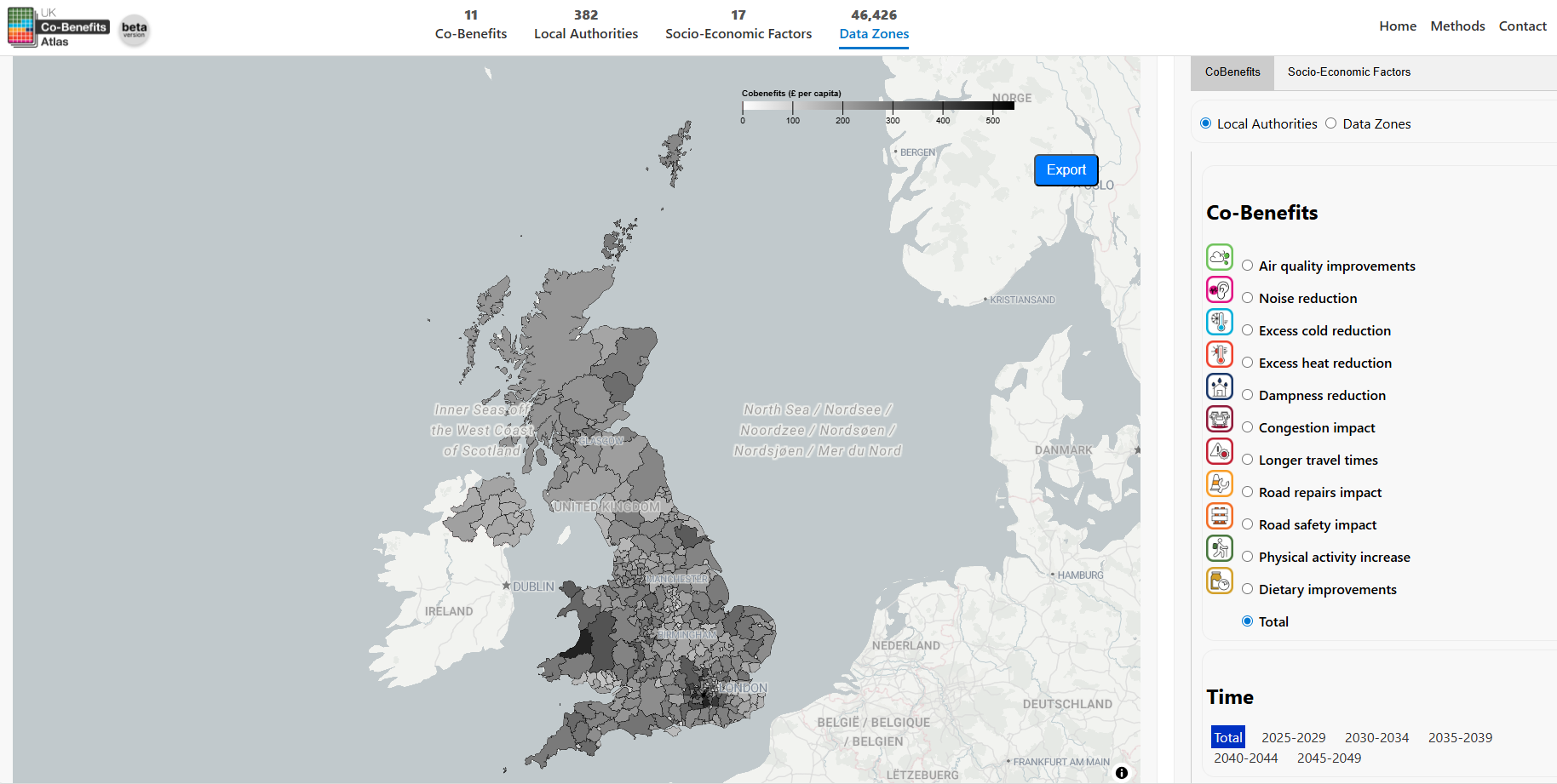 The Atlas is an open resource, and anyone can look up their area and explore estimates of the multiple benefits the net zero transition can bring. If you have any questions regarding the UK Co-Benefits Atlas or want to get in touch, you can read more here and contact the team at cobens@ed.ac.uk.
SCIS Insights: The Social Benefits of Climate Action Series
The CO-BENS Team are also supporting SCIS to identify the best ways to integrate co-benefits into our capacity-building programme for local authorities.
To start, we are publishing a series of briefings that communicate the win-wins for key activity shift areas alongside the interventions associated with delivering them. We cover localised examples but also touch on some benefits not modelled by the CO-BENS team.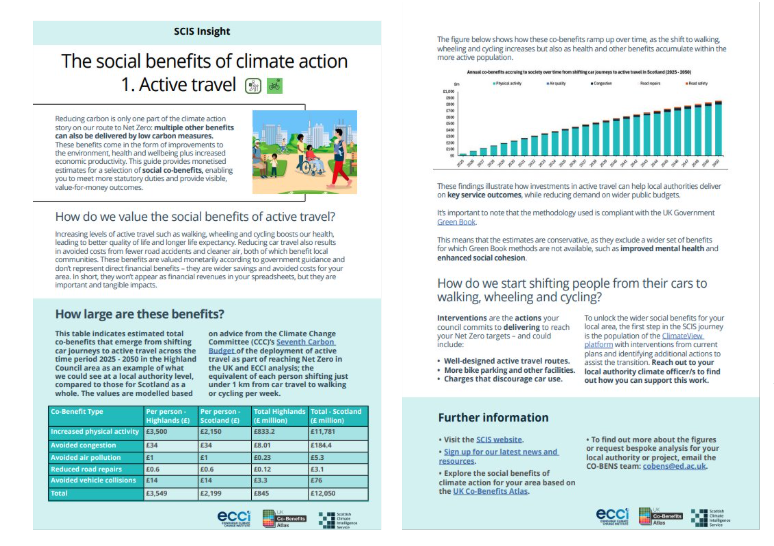
In line with SCIS strategy of starting where local authorities can have the most impact, these are being published in the following order:
- Active travel (read here)
- Electric vehicles (read here)
- Heat pumps (read here)
- Heat networks (read here)
- Public transport (coming soon!)
You can also stay on-top of publication by keeping an eye on our website and following us on LinkedIn.
What’s next?
If you work at Scottish local authority, chat with your Local Lead or climate change team about the the Atlas, the co-benefits briefings and how to bring co-benefits into your decision making. Local Leads will also reach out to climate officers to discuss other ways you can get involved in future developments.
At SCIS, we’re committed to supporting effective climate decision-making that advances just and equitable futures. From empowering local authorities to collaborating with key delivery partners, we are aiming to build a healthier, more prosperous and resilient Scotland. You can reach the team at info@climateintelligenceservice.scot.